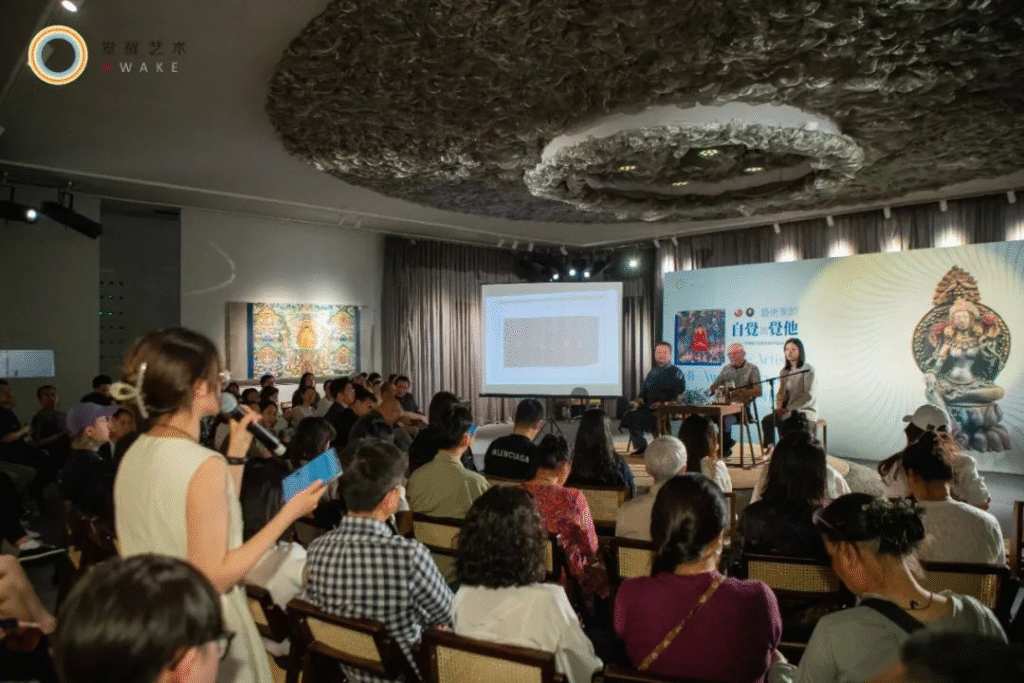
Some of my students are here today. They know that in the past, when I talked about “awakening art,” I focused more on how to use art to practice concentration, meditation, relaxation, and awareness—such as mandala painting. That was my social practice of “awakening art.” Today, we will explore “awakening art” from a different, entirely new perspective, using an artist and his works as an example. This artist is our protagonist today—the Tenth Karmapa Chöying Dorje—and his great creations.
When it comes to his works, the first impression they give is different from the Buddha images we traditionally know. What do we think of when we imagine Buddha images? The Longmen Grottoes, the Leshan Giant Buddha, or the image of Buddha from the 1986 version of “Journey to the West”? Perhaps you think of Buddha as lofty, gilded, and glowing. But when you see the Buddha depicted by Chöying Dorje, the aura conveyed is entirely refreshing. He is not constrained by tradition or form but carries a sense of breath, feeling very close to us, even evoking a tenderness—soft and relaxed.
In fact, Chöying Dorje’s works were influenced by many schools. For example, his sculptures were influenced by Nepalese, Kashmiri, and Swat sculpture art. His paintings were influenced by Chinese art, yet his works are entirely unique. I am reminded of a famous saying by another awakening artist, Shitao, who said in his “Kugua Monk’s Discourse on Painting”: “The method is established by myself.” What does this mean? I call all the shots. This is actually about taking charge in the present moment, fully embracing one’s life potential, and affirming the inherent completeness of one’s life. It means I call the shots, regardless of past rules—I have found my own inner realm of freedom.
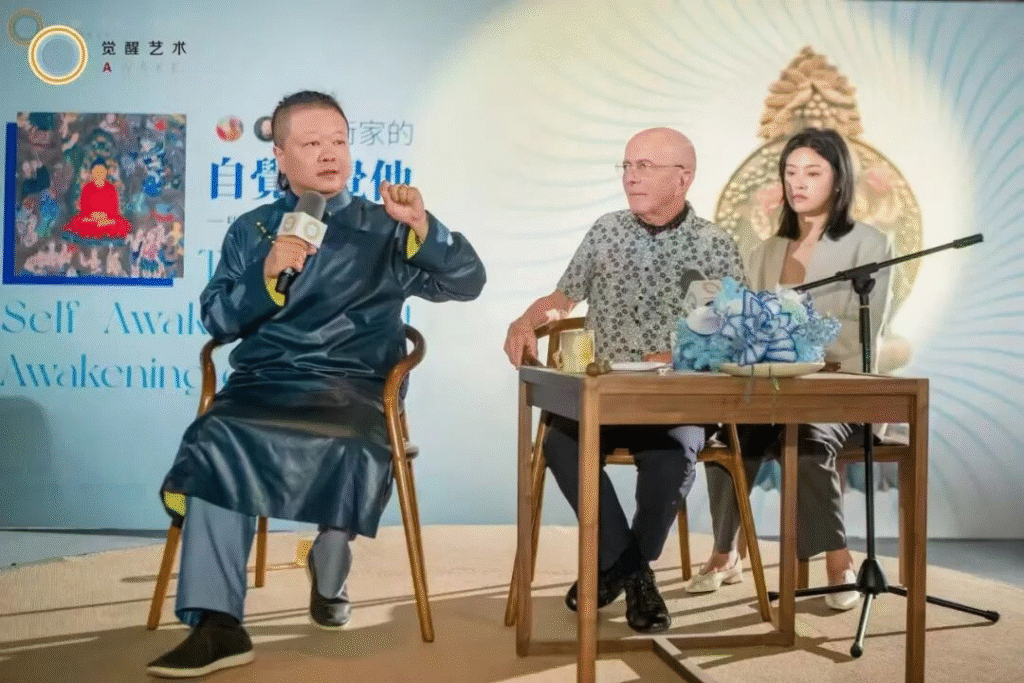
To study an artist’s works and explore the messages conveyed, one cannot separate them from the artist’s life. As the saying goes, “There is no art, only artists.” For a practitioner like Chöying Dorje, his works, his life, and his inner practice are inseparable. This brings us back to the era Chöying Dorje lived in. What kind of figure was he? What kind of life did he experience that led to such creations?
1604–1674—this was the time of Chöying Dorje. It was a critical period when the Gelug school, the last school of Tibetan Buddhism, was rising to prominence. At that time, the Gelug throne holder, Ngawang Lobsang Gyatso, gained the support of the Mongols and launched crushing blows against other schools. At that time, Karmapa Chöying Dorje was also forced to leave Tsurphu Monastery in Lhasa. He traveled through Shangri-La and lived in Lijiang for about 20 years. During this time, he turned his external attention inward, focusing more on his inner world, seeking answers within. In such a turbulent era, finding inner stability was particularly important.
In fact, we may face similar issues. How do we find inner constancy amid competition and pressure? How do we dance with external changes and seek answers? Where did Chöying Dorje find his answers? Art—art even became practice. When engaging in artistic creation, it can greatly help us practice meditation, concentration, awareness, and relaxation. Especially in the Mahāmudrā tradition that Chöying Dorje practiced, mindfulness in awareness is emphasised, which can be practiced during painting. So he found a great treasure, using art as his path of internalised practice, which resulted in many works.
Thus, the Tenth Karmapa Chöying Dorje, after facing such impacts, found an inner path to awakening. This also stemmed from his character, born in Kham. His hometown was Golok in Qinghai, so he had the freedom, unrestrained, openness, and inner breadth of a nomad. He even said this at Pabongkha in Muya:
“In Tibet, no one can match my works, whether in poetry or painting, because I am the one who can bring joy to Avalokiteśvara. I, Chöying Dorje, came into this world for art.”
Shitao once said: “The beard and hair of the ancients do not grow on my face; I have my own face.” This means finding the source of one’s inner creation. From a Buddhist perspective, this is called the vitality of the dharma realm. Often, when we speak of emptiness in Buddhism, it does not mean nothingness but is filled with infinite possibilities. Within these infinite possibilities lies the vitality of the dharma realm—limitless vitality.
As in Zen, the Sixth Patriarch Huineng, upon realising the true nature of all phenomena, said, “How wondrously the self-nature gives rise to all dharmas.” This means our lives possess infinite potential. This potential is a tremendous wealth that we may have forgotten, like a flea placed in a cup that can only jump as high as the cup. Even after the cup is removed, it still jumps only to the height of the original cup. Its infinite potential is forgotten.
Similarly, our mind is like a crystal—clear and pure but also containing infinite potential. When light shines on it, a rainbow appears within the crystal. As this rainbow extends infinitely outward with its boundless creative force, it manifests all of samsara and nirvana. This is called the wondrous power of awareness, the vitality of our lives.
In fact, each of us, like Chöying Dorje, possesses infinite inner potential. I think this is the true Rinpoche Chökyi Gyalpo). “Rinpoche” means precious. A teacher who helps you recognise that you are equally precious is called a Rinpoche. After “Rinpoche” comes another name: Dharma King (Chökyi Gyalpo). “Dharma” (Chö) refers to the true nature of all phenomena. “King” (Gyalpo) means the ruler, the master of life. Such a teacher, who helps you find the master of your own life, can be called the Precious Dharma King of your life.
In the “Records of the Grand Historian,” Sima Qian said: “King Wen, while confined, expanded the ‘Book of Changes’; Confucius, in adversity, composed the ‘Spring and Autumn Annals.'” When we encounter external adversities, how to adjust our inner drive and activate our infinite potential is actually a lifetime task for everyone. So, I think this is also an inspiration from Chöying Dorje: we too possess such infinite potential in our lives. Your own life is a tremendous treasure.
Sometimes we are trapped by two things: fear and laziness. Fear and laziness make us comfortable and secure in our comfort zones, making us afraid to move forward, even afraid to be ourselves. Thus, our lives are filled with acting. Once, I chatted with an actor friend and asked, “When are people most relaxed?” He told me: when there is no one around you. Because as soon as someone appears, the performance begins. We pretend to be okay. We play many roles, put on many masks, but lose ourselves! We hope to buy authentic artworks in collecting, but we live as counterfeits of our own lives! Can you find the unique yourself in this world?
Everyone in this world is so unique, so precious. We come into this world only once. Can we have true sincerity in life, true passion in work, and true faith in life? Like our other keynote speaker today, Mr. Schroeder, whose dedication to one thing for 60 years is truly inspiring, driven by infinite inner love. Your life too contains a great treasure. If you can discover it and find it, you too can become your own “Precious Dharma King (Rinpoche Chökyi Gyalpo).”