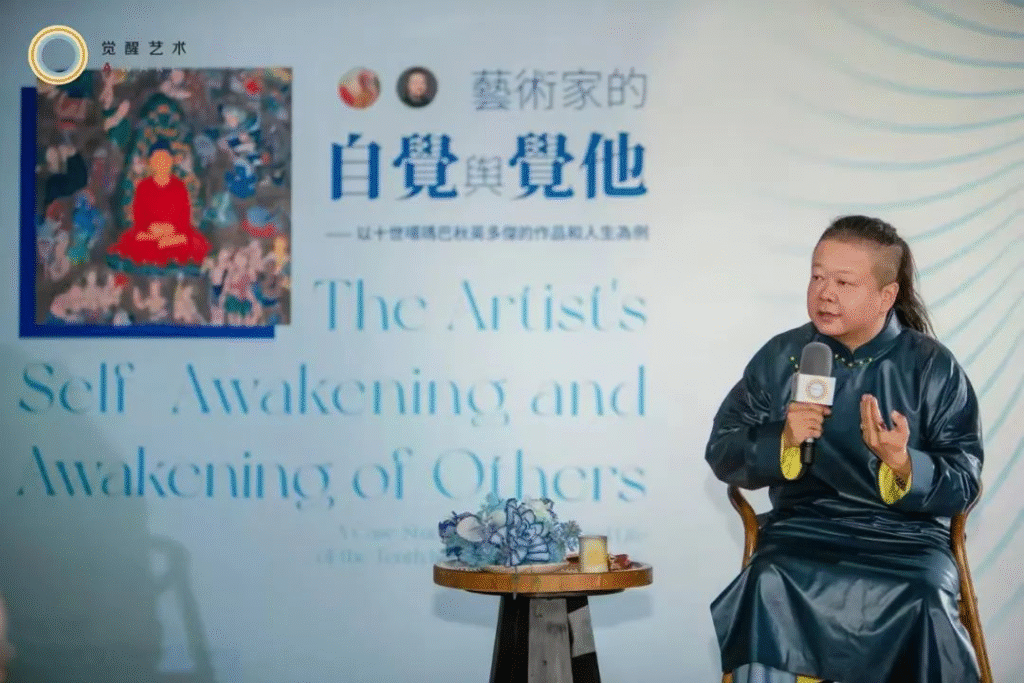
For so many years, I’ve been pondering one question: What else is art good for? Collecting (an audience member answered)—yes, art has a market function; it can be bought and sold. What else? In ancient times, when a crime was committed, wanted posters with portraits were put up—this is art’s propaganda and recording function. Primitive cave dwellers hunted a deer, and people would depict such scenes in caves—this is art’s situational function. As human history evolved, the functions of art continued to diverge. For example, the situational function was somewhat replaced by the invention of film, and the recording function was somewhat replaced by the invention of photography. Even the aesthetic function has been continually reinterpreted or replaced. Contemporary art has also undergone many functional changes.
We all know of the famous painter Cézanne, who is called the father of modern art. Before Cézanne, we described the world, but starting with him, the artwork itself became a world. Art broke free from its mimetic and recording functions and took a step forward. Then came Picasso: not only did the artwork become an independent world, but Picasso no longer served the retina, no longer conveyed spirit and ideas through figurative expressions. Art began to become freer. Then came Duchamp, who directly brought a urinal into the exhibition hall, breaking the boundaries of traditional definitions of art. Later, Beuys proposed the concept of social sculpture: everyone is an artist, liberating artworks from the exhibition hall and bringing them into the broader perspective of social activities.
So art is constantly being pushed forward, constantly being redefined. In fact, this is also a process where, alongside technological development and changing social needs, the function of art is continually pressured and redefined. So, I’ve been thinking: What exactly is art? What relationship does it still have with us? What else can art do? This is a question worth pondering for each of us.
With such inquiry and reflection, I began my journey and ultimately discovered that art has another important function, which I call the awakening function of art. What is the awakening function? It is through art and artworks that we can better see the completeness and perfection of our inner lives. I once said: In our lifetime, you may miss out on anything, but the one thing you cannot miss is your own perfect self, because you don’t even know how perfect you are, with what infinite possibilities and potential.
The awakening function exists in ancient artworks and also in modern artworks. For example, have you seen Xu Bing’s works? “Book from the Sky,” “New English Calligraphy,” etc. When you see such works, there is a moment of astonishment that challenges your intellect. In that moment, your mind stops, but a vast inner space opens up, and within that space lies freedom. I call such works awakening artworks.品。